Is There a Better eVSM Alternative for Process Modeling in 2026?

Last Updated: November 19, 2026
Quick Summary
SymplProcess is a strong evsm alternative for teams that need bottleneck analysis and staffing math, because its tools run as single files in any browser with no installation. It stores data locally on your device and is bought as a one-time purchase or subscription.
- Bizagi Modeler offers a free route into BPMN 2.0 for standard-compliant maps auditors can read.
- Migrating a value stream map to a BPMN tool means redrawing it and re-entering cycle-time and inventory data.
- Signavio and Camunda pricing is quote-based, so verify licensing, add-ons and exit terms with the vendor.
- Match the tool to this quarter's problem rather than the maturity you hope to reach.
- If your team cannot install software freely, require an offline, browser-based option.
Table of Contents
- Why Teams Look for an eVSM Alternative for Process Modeling
- Quick Comparison: Best Process Modelling Tools at a Glance
- SymplProcess: Offline-First Process Modeling Software for Restricted IT Environments
- Bizagi Modeler and the Best BPMN Tools for Standard-Compliant Mapping
- Lucidchart: Visual Collaboration for Value Stream and Process Mapping
- Process Simulation Software Compared: SAP Signavio and Camunda
- Which eVSM Alternative Fits Your Team Size and Modeling Maturity?
- Start From Your Bottleneck: Choosing the Right Modeling Tool
- Frequently Asked Questions
Why Teams Look for an eVSM Alternative for Process Modeling
The search for a better eVSM alternative for process modeling usually starts with a practical problem: the value stream map you need does not fit the tool you have. Teams in manufacturing, warehousing and repair shops tell us the map looks fine on the wall, but it does not help anyone find the bottleneck or decide staffing. Teams in these roles most often need a model that answers a question, not a poster.
Value stream mapping charts material and information flow from order to delivery, marking where time, capacity and labor are lost. A good map leads to decisions; a weak one just gets filed.
That gap is why so many teams look for an eVSM alternative. Three frustrations come up again and again:
- Documentation nobody uses. Maps get drawn once, then rot. Practical guidance on how to document business processes that people actually use beats another diagramming license.
- Restricted IT environments. Plant and warehouse teams often cannot install new software. Web-only tools stall at the first login.
- Analysis stops at the picture. A current-state map with no capacity math does not tell you where the constraint sits.
Below, we compare several process modeling software options, what each does well, and which fits your team size and modeling maturity.
Quick Comparison: Best Process Modelling Tools at a Glance
The best process modelling tools split into two camps: visual mappers that make diagrams easy, and analytical tools that turn a map into numbers. The choice comes down to whether you must model offline and whether you need bottleneck math.
| Tool | Best For | Offline Use | BPMN Support | Pricing Model |
|---|---|---|---|---|
| SymplProcess | Bottleneck analysis, staffing, offline plants | Yes, single files in any browser | Process mapping focus | One-time or subscription |
| Bizagi Modeler | Standard-compliant documentation | No | BPMN 2.0 | Free tier available |
| Lucidchart | Fast visual collaboration | No | Shape library | Subscription |
| SAP Signavio | Enterprise mining and simulation | No | Yes | Enterprise, quote-based |
| Camunda | Model-to-automation workflows | Desktop Modeler | BPMN, DMN, CMMN | Free tier, quote-based |
Use this table to shortlist, then read the section for your situation.
SymplProcess: Offline-First Process Modeling Software for Restricted IT Environments
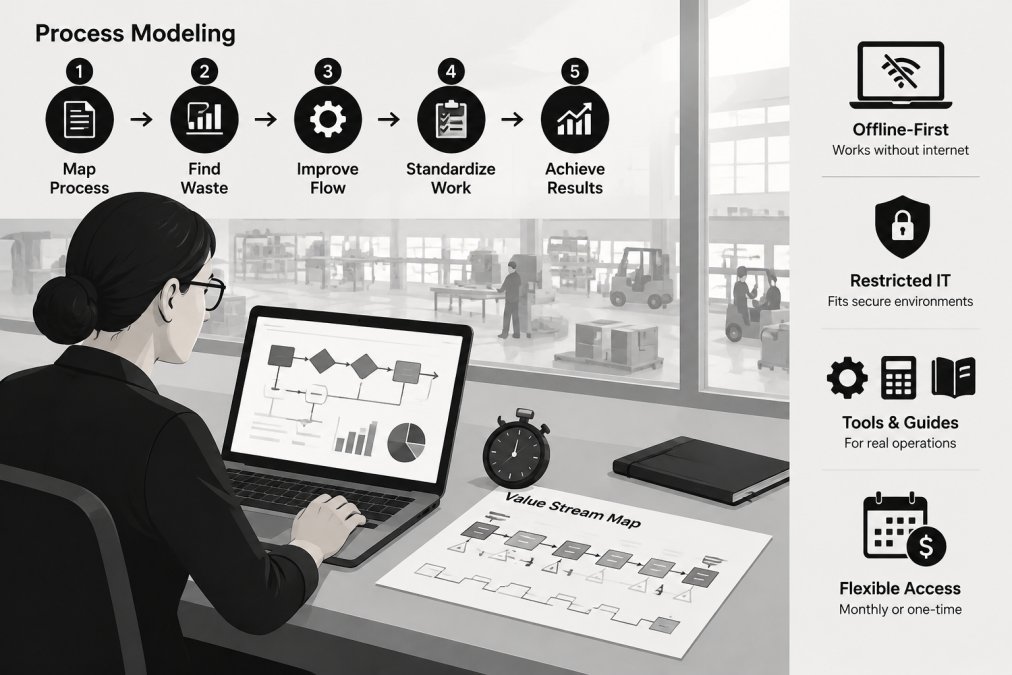
SymplProcess is built for teams that need process modeling software to work where installation is blocked or the internet is unreliable. See the Process Modeler for offline process modeling that finds the bottleneck, balances headcount by team and compares scenarios. Our tools run as single files in any modern browser, so an engineer can open a model on a plant laptop with no admin rights and no connection.
What sets it apart for value stream and bottleneck work:
- Files stay on your machine. Data is stored locally on the device, not in the cloud.
- One-time purchase or subscription. Buy individual offline files outright, or use web-based tools on a monthly subscription.
- Desktop app for Windows that gathers every tool into one library window.
- Units and examples adapt to your inputs, so a mixed-model line does not need manual conversion.
- Free guides and learning tracks for teams building modeling skills from scratch.
The one limitation: it is built for analysis, not enterprise process mining. If you need to mine ERP data across a global estate, read the Signavio section. If you need to find the constraint on a line and staff it correctly, start with our free process modeler to find the bottleneck and staffing in your browser.
Bizagi Modeler and the Best BPMN Tools for Standard-Compliant Mapping
Bizagi Modeler offers a free route into BPMN 2.0, and that standard matters when your maps must be read by people outside your team. BPMN, or Business Process Model and Notation, is a shared diagramming language for business processes (About the Business Process Model and Notation Specification Version 2.0.2). If a quality auditor or supplier needs to read your map without a translator, BPMN compliance is worth the extra discipline.
Where Bizagi earns its place:
For teams whose main need is a clean, standard map, that trade-off is fine. For teams chasing a bottleneck, it is not enough on its own.
What to compare when BPMN compliance is the requirement
BPMN tools differ on several practical points beyond diagram shapes. Use this framework when you shortlist:
- Standard coverage. Does the tool support the BPMN 2.0 elements you actually use, pools and lanes, message flows, boundary events, sub-processes, or only the basic task-and-gateway set?
- Import and export fidelity. Can you round-trip a BPMN 2.0 XML file without losing layout or metadata? Test this with a real file before committing.
- Model-to-execution path. If your roadmap includes automation, check whether the modeling tool is the same product as the execution engine.
- Collaboration and review. If your maps go through formal review cycles, test the comment and approval workflow before you commit.
Migrating from eVSM to a BPMN tool
A common pattern is to keep the value stream map as the analysis layer and use a BPMN tool as the documentation layer. Migrating a value stream map to a BPMN tool usually means redrawing the current-state map in BPMN notation and re-entering cycle-time and inventory data. Budget more time than a vendor demo suggests, since information-flow arrows do not map one-to-one onto BPMN message flows.
Verify import fidelity with one real map before planning a migration.
If your goal is a standard-compliant map for auditors, Bizagi or Camunda Desktop Modeler is the right shortlist. If your goal is bottleneck math on a production line, a BPMN tool will document the process but will not calculate the constraint for you.
Lucidchart: Visual Collaboration for Value Stream and Process Mapping
Lucidchart is suited to fast visual collaboration. Teams can build a current-state map and share it with others for comments during early-stage mapping.
Process Simulation Software Compared: SAP Signavio and Camunda
SAP Signavio and Camunda address different problems: Signavio is oriented toward analysis at scale, while Camunda is oriented toward execution.
How the two tools actually simulate
The simulation mechanisms differ in a way that matters for process modeling work:
For discrete-event simulation of a production line, arrivals, queues, resource pools, shift patterns, neither tool is a substitute for a dedicated simulator. Our guide on simulation and process modeling covers when to build a discrete-event model and how to validate it before you trust the output.
Licensing, cost, and what to verify
Pricing for these products is generally quote-based rather than published for direct comparison. Check each vendor's current terms for licensing and implementation costs. Before you shortlist either, ask the vendor for:
- The licensing model (named users, process instances, or platform fee) and how it scales as usage grows
- Implementation and integration effort, including connector work for your ERP
- Whether simulation or mining is included in the base tier or sold as an add-on
- Exit terms: can you export your models and mining data in an open format if you leave?
Interoperability and migration
Both tools import and export BPMN 2.0 XML, the practical bridge if you are moving models between tools. Teams switching from eVSM should expect to rebuild value stream maps as BPMN diagrams and re-enter cycle-time and inventory data, because value stream map data does not transfer automatically into most platforms.
If you are weighing simulation against simpler calculation, start with the question you need answered. Capacity and staffing questions on a single line are usually faster to answer with a focused analytical model than with an enterprise mining suite.
Which eVSM Alternative Fits Your Team Size and Modeling Maturity?
The right eVSM alternative depends less on feature lists and more on two questions: how many people will use it, and how mature your modeling is.
- Small teams, early maturity. A 40-person floor needs fast maps and clear bottleneck answers, not enterprise governance. Start with a free browser modeler and grow from there.
- Mid-size teams with shifting bottlenecks. If the constraint moves week to week, pick a tool that makes updates quick. Heavy re-modeling slows momentum.
- Large enterprises with operational data. Mining and simulation earn their cost when you have ERP data to mine and a global estate to govern.
- Production lines sized from a rate. Teams building a line from a target rate and routing can use the floor simulator to model people, machines and flow time.
A common mistake is buying for the maturity you hope to reach rather than the one you have. Match the tool to this quarter's problem.
Start From Your Bottleneck: Choosing the Right Modeling Tool
Choosing a process modeling tool is easier when you start from the constraint instead of the feature list. A tool that helps you find and fix your bottleneck now is often more useful than a suite promising longer-term transformation.
Here is how we would decide:
- Can your team install software freely? If not, require an offline, browser-based option.
- Do you need standard BPMN output for auditors or partners? If yes, Bizagi belongs on the list.
- Is collaboration the main need? Lucidchart gets a team mapping fast.
- Do you need to mine ERP data and simulate at scale? Signavio or Camunda fit.
- Do you need bottleneck math and staffing on a line? Start analytical, not visual.
- What is the total cost of ownership, including training and re-modeling time?
Consider the rework cost when a tool cannot keep up with a moving bottleneck, not only the license price.
Most process modeling stalls because the tool answers the wrong question. If your real problem is finding the constraint and staffing to it, model it directly. SymplProcess gives you offline tools that run without installation, bottleneck and staffing analysis that adapts to your units, and one-time or subscription access so you only pay for what you use. Get started with SymplProcess and turn your next value stream map into a decision.
Frequently Asked Questions
What should I look for in an eVSM alternative?
Focus on four things: whether it supports value stream mapping and process modeling in one place, how it handles offline or restricted-IT environments, what the pricing model actually commits you to, and whether it can import operational data from ERP or spreadsheets. For manufacturing teams, offline capability and unit-adaptive examples matter more than enterprise integrations. Match the tool to your modeling maturity rather than buying the most feature-heavy option.
Is value stream mapping the same as process mapping?
No. Process mapping documents the steps and decision points in a workflow, often using BPMN notation. Value stream mapping adds material and information flow, plus metrics like lead time, cycle time, and inventory between steps. Many teams use both: process maps for detailed procedure design, value stream maps for spotting waste across the whole production flow. A good eVSM alternative should handle both views without forcing you into separate tools.
What is the difference between process modeling and process simulation?
Process modeling is the act of documenting how a process works: the steps, resources, decision logic, and timings. Process simulation takes that model and runs scenarios through it, using discrete-event simulation to test capacity, throughput, and bottleneck behavior before you change anything on the floor. Tools like SAP Signavio and Camunda lean toward simulation and automation, while mapping-first tools focus on documentation and visual analysis.
Which process modeling tools support manufacturing workflows?
Look for tools built for your type of operation. SymplProcess is built for manufacturing, warehousing, and repair shop workflows, with tools that adapt units and examples to your input.
Can I use an eVSM alternative without installing software on company machines?
Yes, if you choose a browser-based tool that runs as a single offline file. SymplProcess offline files open in any modern browser without installing software, and files remain on your machine. That suits plants with restricted software installation.
